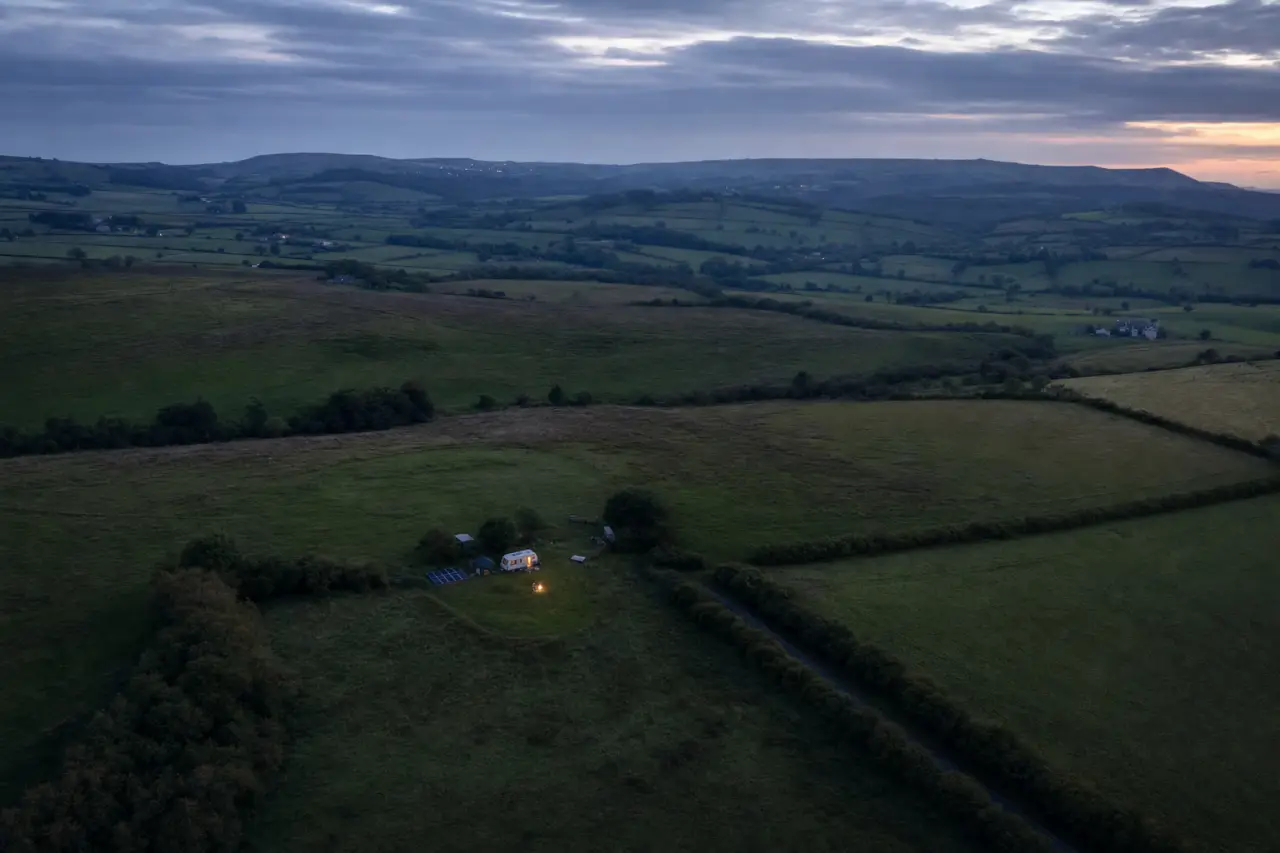
The honest answer
Living in a caravan off-grid in the UK—whether that's on your own land or someone else's—almost always requires planning permission if it is your main residence. The fact that you are off mains water, electricity and sewage does not exempt you from planning control. "Off-grid" describes your services, not a legal status that bypasses the Town and Country Planning Act 1990.
Many people believe that the 28-day permitted development rule, or the fact that a caravan is mobile, means they can station one on agricultural or woodland land and live in it without consent. That is not correct. The 28-day rule applies to temporary uses on land that is not your main home; living somewhere permanently is residential occupation and is development that needs permission. Enforcement is real, and local planning authorities can—and do—issue enforcement notices requiring you to stop occupying the land or to remove the caravan.
This guide explains living in a caravan off grid UK law as it stands in 2026, corrects the common myths, and shows you how to check whether a specific plot can lawfully support off-grid caravan dwelling. For the full detail on caravans, mobile homes and tiny houses—whether off-grid or not—read our companion guides Can You Live in a Caravan on Your Own Land? and Living on your own land: mobile homes, caravans & tiny houses.
Frequently asked questions
Got a specific plot in mind for off-grid caravan living?
Enter the plot's postcode and we'll check planning status, green belt, Article 4, flood risk and lawful access, in plain English.
£34, results in minutes, no account needed. Or see a sample report first.
Is it legal to live in a caravan off-grid in the UK?
Can I live in a caravan off grid without planning permission?
Does the 28-day rule let me live in a caravan on my own land?
Can I put a caravan on agricultural land and live in it off-grid?
What happens if I live in a caravan off-grid without permission?
How much land do you need to live off-grid in a caravan in the UK?
Living in a caravan off grid UK: the planning reality
Off-grid does not mean exempt from planning permission
The single most dangerous misconception is that because you are not connecting to public utilities, you somehow fall outside planning control.
You do not.
Under the Town and Country Planning Act 1990, a "material change of use" of land is development, and development requires planning permission unless it is expressly permitted by legislation or a local development order. Using land as your main residence—placing a caravan on it and living in it—is almost always a material change of use from agricultural, forestry or amenity use to residential (Class C3).
The fact that you draw water from a borehole, generate power with solar panels and treat sewage in a septic tank is irrelevant to the question of whether you need planning permission to live there. Those are servicing questions; planning permission governs the use of the land.
This applies equally in England and Wales. (This guide addresses general UK principles, but be aware: Wales has One Planet Development under TAN 6, which can permit off-grid residential dwellings on agricultural land if you meet strict criteria. England has no equivalent policy.)
The 28-day myth and what it really means
The Caravan Sites and Control of Development Act 1960 and the Town and Country Planning (General Permitted Development) (England) Order 2015 (Schedule 2, Part 4, Class B) allow certain temporary uses of land for up to 28 days in any calendar year without needing express planning permission.
What this does NOT allow:
- Living on the land as your main or sole residence, even for part of the year.
- Stationing a caravan permanently (or semi-permanently) and using it as a dwelling.
- Claiming that because the caravan is "mobile" you are not occupying the land.
What it DOES allow:
- Genuinely temporary, ancillary uses—for example, a shepherd's hut used for lambing for a few weeks, or occasional recreational camping that is clearly not your main home.
If you are living in the caravan—receiving post there, registered to vote or with a GP there, spending the majority of your nights there—you are in residential occupation. The 28-day rule will not protect you, and the fact that the caravan has wheels is immaterial. Planning enforcement officers assess use, not the physical form of the structure.
When is a caravan not "permitted development"?
There is no blanket permitted development right to station a caravan on your own land and live in it. Permitted development rights (set out in the General Permitted Development Order) cover specific, narrow scenarios—primarily certain building works within the curtilage of an existing lawful dwelling, or temporary uses as described above.
If the land does not already have lawful residential use, placing a caravan on it and occupying it as a dwelling is a change of use that requires planning permission. If the land is in a designated area (a National Park, Area of Outstanding Natural Beauty, Conservation Area, the Broads, or a World Heritage Site), or if an Article 4 Direction is in force, permitted development rights may be further restricted or removed.
In short: assuming you can live off-grid in a caravan because it is movable, or because you own the land, is a planning law misunderstanding that can result in enforcement action, fines, and an order to vacate.
Off grid caravan living UK: what the law actually allows
Residential curtilage and ancillary use
You are generally allowed to station a caravan within the curtilage (the garden or grounds) of an existing, lawful dwelling and use it for purposes ancillary to that dwelling—for example, as a home office, guest annexe, or hobby room—provided it does not become a separate unit of residential accommodation (a separate home).
If you live in a house and want to put a caravan in the garden for occasional guests or as a garden office, that is usually lawful. If you (or a family member, or a paying tenant) start living in it as a separate, self-contained home, that is likely to be a material change of use requiring permission.
Crucially, this ancillary caravan can be entirely off-grid (solar, rainwater, composting toilet) without affecting its planning status—because it is ancillary to a lawful dwelling, not a dwelling in its own right.
For the legal tests and case-law on ancillary versus independent occupation, see our full guide Can You Live in a Caravan on Your Own Land?.
Agricultural and forestry workers' dwellings
There is a well-established (but difficult) route to obtaining planning permission for a dwelling—including a mobile home or caravan—on agricultural or forestry land if you can demonstrate a genuine functional and financial need for a worker to live on-site.
The tests (set out in the National Planning Policy Framework and in planning case-law) are strict:
- Functional need: The nature and scale of the enterprise requires a full-time worker to be present on-site (for example, to care for livestock, manage a horticulture business, or undertake forestry operations that cannot reasonably be performed from a dwelling elsewhere).
- Financial test: The business is viable, established (or has a clear, funded business plan), and can sustain the employment and the dwelling.
- Proportionality: The size and form of the dwelling must be proportionate to the need. You cannot claim a need for a worker's dwelling and then build (or station) a large residential property.
Temporary permissions (often three years) for a caravan or mobile home are commonly granted while the business establishes; if the tests continue to be met, a permanent dwelling may then be permitted.
This route is available in both England and Wales, and it applies whether the dwelling is on-grid or off-grid. The planning question is need, not services.
For England-specific plot checks and planning history, use the BuyLand Plot Report (see a sample report here).
One Planet Development (Wales only)
Wales has a policy framework—One Planet Development, set out in Planning Policy Wales and Technical Advice Note 6—that can grant planning permission for off-grid residential dwellings on agricultural or forestry land if the applicant commits to meeting at least 65% of their household needs from the land within five years, and demonstrates a low ecological footprint.
This is the closest thing in the UK to a formal "live off-grid on your own land" planning route. It is not easy (the business plan, management plan and annual monitoring are onerous), but it is a genuine lawful pathway.
Crucially, One Planet Development does not exist in England. There is no equivalent policy. If you are looking at land in England and someone suggests you can apply for "one planet" permission, they are mistaken. See our guide One Planet Development in Wales: The Lawful Off-Grid Route for the full detail.
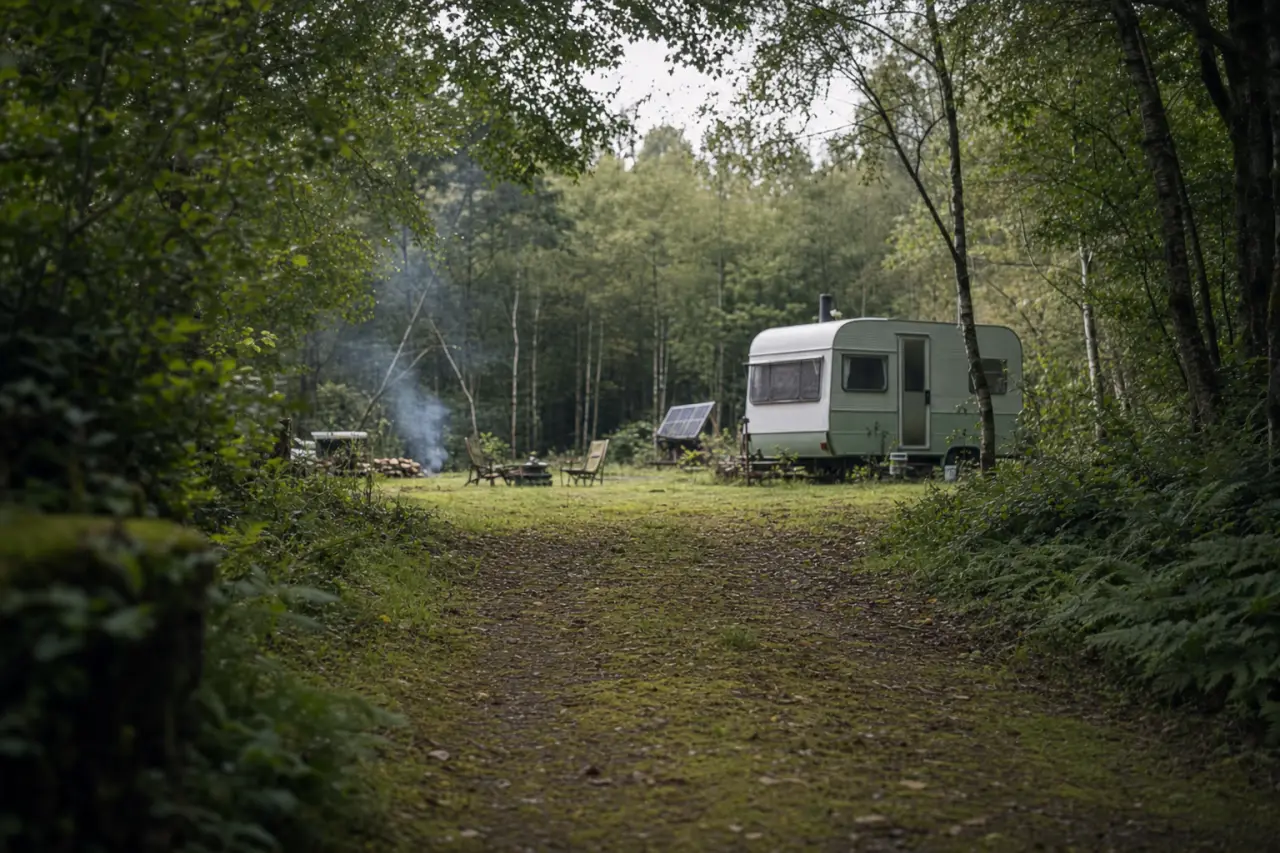
Can I live in a caravan off grid: the scenarios and risks
Buying land and moving a caravan onto it
You buy a few acres of woodland or agricultural land. You move a caravan onto it. You install solar panels, a rainwater harvesting system and a composting toilet. You start living there.
Planning status: You are almost certainly in breach of planning control. The change of use from agriculture/forestry to residential requires permission, and you do not have it. The off-grid services do not change that.
Enforcement risk: Councils vary, but many do enforce. You may receive an enforcement notice requiring you to cease occupation and/or remove the caravan. Ignoring an enforcement notice is a criminal offence. In some cases, councils may invite a retrospective planning application, but you have no right to demand one, and it may be refused.
Living in a caravan "temporarily" while you build
Some people move a caravan onto land while they (ostensibly) prepare to build a house, or establish a smallholding. If you do not have planning permission for the dwelling, and you do not meet the agricultural worker tests, you are occupying the land unlawfully.
If you do have planning permission to build a house, some councils will accept a temporary caravan on-site during construction (sometimes as a planning condition, sometimes informally). This is genuinely temporary, tied to the build, and ceases when the house is completed or the build is abandoned.
Using a caravan as a "stepping stone" to establish residential use on land that does not have permission is not lawful and is likely to result in enforcement.
The "no one will notice" gamble
Some land is remote. Some councils are under-resourced. It is true that not every breach is detected or pursued immediately.
But enforcement has no time limit for ongoing breaches (though after four years of continuous residential use as a caravan site, or ten years for other breaches of planning control, the use may become immune from enforcement under the "four-year rule" or "ten-year rule"—but this is a high-risk, legally complex strategy that can fail, and we cannot recommend it).
Planning enforcement can be triggered by a neighbour complaint, an aerial survey, a routine site visit, or even a casual mention on social media. Once an investigation is opened, you may be required to provide evidence of lawful use, and absence of evidence is not evidence of permission.
If you are relying on not being noticed, you are gambling, not complying.
What you need to check before living in a caravan off-grid
Planning permission and planning history
- Does the land have any existing or historic planning permissions?
- Is there a lawful residential use, or a Certificate of Lawfulness for residential occupation?
- Are there any enforcement notices, breach of condition notices, or planning contravention notices on record?
- Is there an agricultural occupancy condition or other restriction on an existing dwelling?
You can search the local planning authority's online planning register (every council in England and Wales has one), or submit a formal pre-application enquiry. For England, the BuyLand Plot Report consolidates much of this in one document (see a sample here).
Designations and constraints
- Is the land in a National Park, Area of Outstanding Natural Beauty (AONB), Conservation Area, Site of Special Scientific Interest (SSSI), or flood zone?
- Is there an Article 4 Direction removing permitted development rights?
- Are there tree preservation orders (TPOs) or ecological designations that restrict what you can do?
Designations do not necessarily block off-grid caravan dwelling, but they raise the bar for obtaining planning permission and can restrict ancillary works (access tracks, septic tanks, solar arrays).
Access, water and waste
While these are not, strictly speaking, planning permission issues, they are essential feasibility checks:
- Legal access: Do you have a right of way to the land that permits residential use? Agricultural access rights often exclude residential traffic.
- Water supply: Can you lawfully abstract water (from a borehole, spring or stream)? Abstraction of more than 20 cubic metres per day requires an Environment Agency licence (in England) or a Natural Resources Wales permit. See Water Supply on Off-Grid Land in the UK: What to Check.
- Sewage treatment: Can you install a septic tank or treatment plant, and obtain the necessary environmental permits and building control sign-off?
- Flood risk: Will the Environment Agency or Natural Resources Wales object to residential occupation in a flood zone?
None of these replace the need for planning permission; they are additional consents and checks.
For a broader checklist, see Buying Land to Live Off-Grid: What to Check Before You Buy.
How to check a specific plot
If you are serious about a piece of land and want to understand whether you can lawfully live in a caravan on it (off-grid or otherwise), here are the real due-diligence steps:
Planning status and history
Search the local planning authority's planning register for the site. Look for any permissions, refusals, appeals, enforcement notices, or conditions. In England, order a BuyLand Plot Report to consolidate much of this (sample report here).Green Belt, National Park, AONB, and other designations
Check whether the land falls within a designated area. The Planning Portal (GOV.UK) and your local planning authority's local plan maps will show this. Designations make new residential use much harder to justify.Article 4 Directions
Some areas have Article 4 Directions that remove permitted development rights. Your local planning authority holds the register.Flood risk and environmental constraints
Use the Environment Agency's flood map for planning (England) or Natural Resources Wales flood maps. Check for SSSIs, ancient woodland, and other environmental designations that may restrict occupation or works.Lawful access and rights of way
Examine the title deeds and any rights of way. Does the access permit residential use, or only agricultural/forestry?Water abstraction and discharge consents
Contact the Environment Agency (England) or Natural Resources Wales to understand abstraction licensing and septic discharge rules for the plot.Pre-application advice
If the plot looks promising but you are unsure, pay for formal pre-application advice from the local planning authority. It is not binding, but it gives you a clear steer before you buy.
For the planning permission question more generally, see Off-Grid Planning Permission in the UK: When You Need It, and for land-buying checks, Off-Grid Land for Sale: What to Watch For Before You Buy.
The bottom line: off-grid caravan living and the law
Living in a caravan off-grid in the UK is not a legal loophole. It is residential occupation of land, and that almost always requires planning permission—whether you are connected to services or not.
The 28-day rule, the mobility of a caravan, and the romance of self-sufficiency do not change the legal position. If you occupy land as your main home without the necessary permission, you are at risk of enforcement, regardless of how eco-friendly or low-impact your lifestyle.
There are lawful routes: planning permission for a residential caravan (whether as a permanent dwelling, a worker's dwelling, or under One Planet Development in Wales); ancillary use within the curtilage of an existing lawful home; or, in rare cases, immune use following many years of occupation. But each of those routes has tests, evidence requirements, and risks.
If you dream of off-grid caravan living, the first question is not "how much solar do I need?" but "does this plot have, or can I obtain, planning permission for residential use?" Answer that honestly, in writing, before you buy.
For the full picture of off-grid living and planning, start with Can You Live Off-Grid in the UK? The Planning Reality. For the caravan-specific detail (on-grid or off), read Can You Live in a Caravan on Your Own Land? and Living on your own land: mobile homes, caravans & tiny houses. And to check a specific plot in England, order a BuyLand Plot Report.
Get a Free Land Valuation
Use our calculator to get an instant estimate of land value in your area.
Free Valuation