The honest answer
Yes, you can live on your own land in a mobile home, caravan or tiny house in the UK – but not as simply as many people hope. Owning the land does not automatically grant you the right to live on it. In most cases, stationing a caravan or mobile home for residential use counts as a "material change of use" under the Town and Country Planning Act 1990, and that requires planning permission.
There are lawful routes: planning permission granted specifically for residential use, a Certificate of Lawful Development (CLD or CLEUD) proving ten years' continuous residence, or permitted development rights in very limited circumstances. There are also common misunderstandings – the so-called "28-day rule," cheap agricultural land, and the belief that a structure on wheels needs no permission – that lead to enforcement action, eviction and financial loss.
This guide is your hub. We'll explain when living on your own land in a mobile home, caravan or tiny house is lawful and when it isn't, the planning routes that work, the rules that matter, and how to check a specific plot before you buy.
Frequently asked questions
Checking a specific plot for a mobile home or tiny house?
Enter the plot's postcode and we'll check planning status, green belt, Article 4, flood risk and lawful access, in plain English.
£34, results in minutes, no account needed. Or see a sample report first.
Can I live in a caravan on my own land in the UK?
Do I need planning permission to put a mobile home on my own land?
Can you buy land to live on in the UK?
What is the 28-day rule for caravans on private land?
How do I check if land has permission for a mobile home?
Can I get a Certificate of Lawful Development for living in a caravan?
When you can live on your own land (the lawful routes)
1. Planning permission for residential use
The clearest, safest route is to buy land that already has planning permission for a mobile home, caravan or tiny house as a dwelling. This permission will be recorded on the local planning authority's planning register and may specify conditions: number of units, occupancy restrictions (such as agricultural worker or holiday let only), landscaping, drainage or access requirements.
Planning permission runs with the land, not the owner, so if the plot has it, you inherit it when you buy. But always verify the detail: what exactly was permitted, what conditions apply, and whether the permission was implemented and is still valid. We cover this in detail in our guide to land with planning permission for a mobile home.
If the land doesn't have permission, you can apply. Success depends on:
- Local planning policy: some councils designate rural exception sites or allocate small plots for low-impact dwellings; most do not.
- Personal circumstances: an agricultural or forestry worker with a functional need may qualify under the agricultural worker exception (paragraph 80 of the National Planning Policy Framework, NPPF).
- Design and impact: a well-designed, low-impact proposal on previously developed (brownfield) land stands a better chance than a caravan on open countryside.
Planning applications cost £584 (as of 2026 for a single dwelling) and take eight weeks minimum. Refusal is common for rural residential use without a proven need, and appeals are lengthy and uncertain.
2. Certificate of Lawful Development (CLD or CLEUD)
If someone (you or a previous owner) has lived in a mobile home or caravan on the land continuously as their main residence for at least ten years without enforcement action, the use becomes lawful through the passage of time. You can apply to the council for a Certificate of Lawful Existing Use or Development (CLEUD) to formalise this.
The ten-year rule (Section 171B of the Town and Country Planning Act 1990) is real, but the evidence bar is high: council tax records, utility bills, witness statements, electoral roll entries and dated photographs, all showing continuous, unbroken residential occupation. The use must also have been open, not concealed, and the council must not have issued an enforcement notice within that period.
A CLEUD is gold: once issued, the use is lawful permanently. But claims often fail because occupation was interrupted, evidence is incomplete, or the use was mixed (part-time, seasonal or ancillary to another property). Read our full explainer on the certificate of lawful development for a mobile home.
3. Permitted development (very limited)
Under the Town and Country Planning (General Permitted Development) (England) Order 2015, there are narrow rights to station a caravan without planning permission, but not for residential use as a main dwelling:
- Incidental to the enjoyment of a dwellinghouse: you can site a caravan in the garden or curtilage of your existing home for purposes incidental to that home (storage, guest annex, office), but not as an independent dwelling.
- Agricultural or forestry purposes: a caravan used temporarily by a worker for the purposes of agriculture or forestry on that land may be permitted, but this does not extend to permanent residential occupation without a planning permission.
- Holiday or leisure use: some caravan sites benefit from permitted development or existing use rights for holiday lettings, but these explicitly exclude use as a main residence (typically enforced by condition: no occupation for more than 28 days consecutively or by the same person).
The bottom line: permitted development almost never allows you to live in a caravan or mobile home as your main home on your own land without planning permission.
When you cannot live on your own land (and why)
Owning land ≠ the right to live on it
This is the single most important point: ownership of land does not grant planning permission. You can own ten acres outright and still be served an enforcement notice if you station a caravan and live in it without permission. Land ownership gives you property rights; planning law governs what you may do on that land.
Agricultural land and the planning trap
Cheap agricultural land is widely advertised online, often with the implicit suggestion that you can "live off-grid" or "park your caravan." In the vast majority of cases, this is not lawful without planning permission, and planning permission for a dwelling on open agricultural land is rarely granted unless you meet the strict agricultural worker or exceptional design tests.
Agricultural land is cheap precisely because it does not have residential planning permission. Buying it hoping to live there is a gamble that usually ends in enforcement. We cover the reality in agricultural land and mobile homes: why it rarely equals a home.
The "28-day rule" myth
Many people believe they can live in a caravan on their own land for 28 days without permission. This is a misunderstanding of the planning rules:
- The 28-day rule (Part 4, Class B of the GPDO) permits temporary use of land for any purpose for up to 28 days per calendar year without planning permission. This covers markets, car boot sales, seasonal events – not continuous residential occupation.
- Staying in a caravan for 28 days, then moving it or leaving for a few days, then returning, does not reset the clock. If the overall pattern of use is residential, the council can take enforcement action for a material change of use.
- Similarly, the idea that you can live in a caravan "temporarily" while building a house is only lawful if you have planning permission for the house and the caravan use is genuinely ancillary and time-limited.
Do not rely on the 28-day rule to live on land you own. Enforcement officers are experienced at identifying residential use, and the consequences can include an enforcement notice requiring you to leave, prosecution and costs.
Enforcement is real
If you live on your land without permission, the local planning authority can:
- Issue a planning contravention notice (a formal investigation).
- Issue a breach of condition notice or enforcement notice requiring you to stop the use, remove the caravan and restore the land.
- If you fail to comply, prosecute you in the magistrates' court (fines up to £20,000) or seek an injunction in the High Court.
- In extreme cases, direct action: the council can enter the land, remove structures and bill you for costs.
The four-year and ten-year immunity rules (Section 171B) mean that if enforcement isn't taken within four years of a breach (for building works) or ten years (for change of use), the breach becomes lawful. But the clock only starts when the breach begins, it resets if use is interrupted, and councils can act at any time within that window. Hoping to "wait it out" is high-risk and often fails.
The key planning rules you must understand
Stationing a caravan vs residential use
Under the Caravan Sites and Control of Development Act 1960, a caravan site requires a site licence from the local authority if two or more caravans are stationed for human habitation. For a single caravan on your own land, a site licence is not usually required, but planning permission for the change of use to residential is.
The 1960 Act defines a caravan as a structure designed to be moved (by towing or transporting), meeting size limits set out in the Caravan Sites Act 1968 and the 2006 regulations: maximum 20 metres long, 6.7 metres wide, and 3.05 metres internal height. Anything larger (many American-style "park homes" and some lodges exceed these) is not a caravan in law and is treated as a building, requiring building regulations approval and potentially stricter planning scrutiny.
Crucially, whether a structure is on wheels or "mobile" does not determine whether planning permission is needed. A tiny house on a trailer, a static caravan, a shepherd's hut or a yurt used as a dwelling all constitute a material change of use if they become your home, and that requires permission.
The 2013 planning policy on caravan siting
In 2013, the government amended national planning policy to clarify that applications for caravan or mobile home sites should be assessed against the same criteria as applications for conventional housing. This means:
- Councils cannot refuse a mobile-home application purely because it is a caravan rather than a brick house.
- However, applications must still comply with local and national planning policy, including tests on sustainability, access, landscape impact, flood risk and need.
- In practice, many rural mobile-home applications are still refused, especially where policy restricts new dwellings in open countryside.
The policy helps where land is suitable for housing in principle; it does not override Green Belt protection, Areas of Outstanding Natural Beauty (AONB), local occupancy restrictions or other material constraints.
Personal permission vs permission that runs with the land
Some planning permissions are granted personally (to a named individual, often an agricultural worker) and lapse when that person no longer occupies the dwelling or no longer meets the criteria. Others are permanent and run with the land.
Always check the decision notice and conditions. A personal permission can lose its value overnight if your circumstances change, and it cannot be transferred to a buyer. Land sold with "planning permission" that turns out to be personal or conditional is worth far less than the seller may claim.
Can you live in a caravan on your own land?
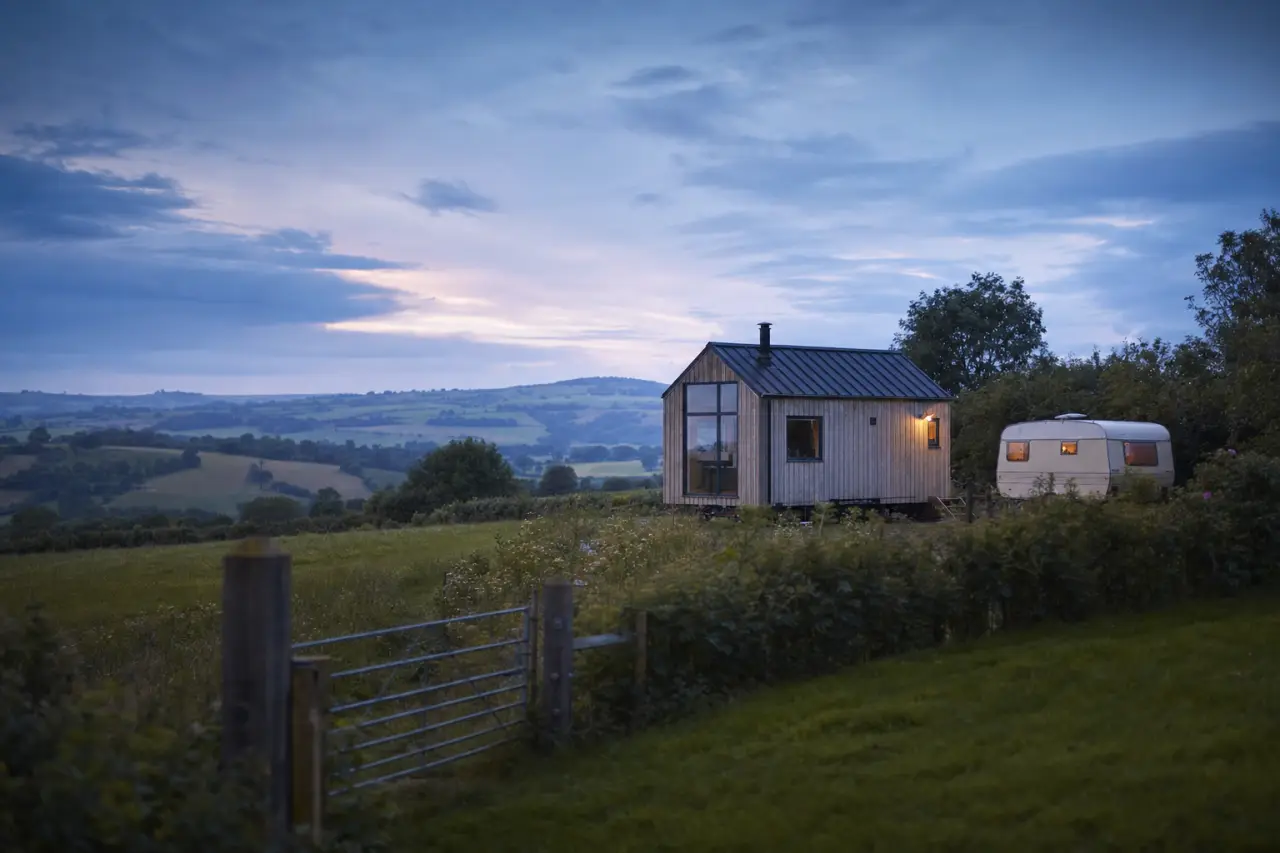
This is one of the most-searched questions, and the short answer is: yes, if you have planning permission or a certificate of lawful development for residential use; no, if you do not.
The detail matters:
- A static caravan (park home) on a licensed residential park is lawful because the park has permission and a site licence.
- A touring caravan or static caravan on your own agricultural or amenity land, used as your home, is a change of use requiring permission in almost all cases.
- Some rural plots are sold with consent for a "mobile home" or "caravan" as a dwelling – these are lawful, but you must verify the permission is implemented, current and not subject to restrictive conditions.
We go deeper on this question in can you live in a caravan on your own land? The rules, honestly.
Tiny houses, shepherd's huts and other "movable" structures
A tiny house on wheels, a shepherd's hut or a converted horsebox may feel different from a static caravan, but in planning law they are treated the same: if you live in one as your main residence, that is residential use of the land, and permission is required.
Some tiny-house advocates cite permitted development or the Caravan Acts. The reality:
- If the structure meets the legal definition of a caravan (size limits, designed to move), it is a caravan; if it exceeds those limits or is a building, it may be subject to Building Regulations and is still a dwelling for planning purposes.
- "Movability" does not exempt a structure from planning control. A horsebox you never move, stationed on land and lived in full-time, is residential use.
- Off-grid features (solar panels, composting toilet) do not bypass the need for planning permission. Sustainability can support a planning application, but it does not replace it.
The same enforcement risks apply. If you want to live in a tiny house on your own land, you need either to buy land with suitable permission or to apply and win consent.
What about agricultural worker dwellings and the NPPF paragraph 80 route?
Paragraph 80 of the National Planning Policy Framework (formerly paragraph 55) allows for new dwellings in the countryside in a few circumstances, including:
- Essential need for a rural worker to live permanently at or near their place of work (agriculture, forestry).
- Exceptional quality or innovative design that is sensitive to the area and enhances it.
The agricultural worker route is real but extremely strict:
- You must prove a genuine functional need (full-time work on that specific farm or holding, not just a desire to keep chickens).
- The enterprise must be established, financially sound and demonstrate a need that cannot be met by existing dwellings.
- Councils often grant a temporary permission (e.g. three years in a mobile home) to test viability before allowing a permanent dwelling.
- Even then, the permission is usually subject to an agricultural occupancy condition, restricting future occupation to agricultural workers or their dependents.
If you are a genuine agricultural or forestry worker with a proven need, this route can work. If you are buying cheap land hoping to argue a smallholding justifies a dwelling, expect refusal. The tests are rigorously applied, and appeals frequently fail.
Green Belt, AONB and other designations
Large parts of England are covered by planning designations that make new residential development – including mobile homes and caravans – very difficult:
- Green Belt: new dwellings are "inappropriate development" and refused unless very special circumstances are proven. Existing buildings may be replaced or extended under permitted development, but stationing a new caravan for residential use is not permitted.
- Areas of Outstanding Natural Beauty (AONB) and National Parks: major development is restricted; even small-scale proposals face heightened landscape impact scrutiny.
- Conservation Areas and listed building curtilage: additional consents may be needed; enforcement is more vigorous.
- Flood Zone 3, Sites of Special Scientific Interest (SSSI), ancient woodland buffer zones: all can prevent or severely restrict residential development.
Before you buy land, check its designations. A plot in Green Belt or AONB without existing permission is unlikely ever to gain consent for a dwelling, no matter how much you invest.
How to check a specific plot
Do not buy land hoping you can live on it without verifying the planning status first. Here's how to check properly:
1. Planning history and current permissions
Search the local planning authority's online planning register (find your council via gov.uk/find-local-council). Enter the postcode or address and review:
- All planning applications, decisions and conditions.
- Enforcement notices or breach of condition notices.
- Certificates of lawful development.
Look for conditions that restrict use (holiday only, agricultural worker, temporary permission) and check the implementation date and any time limits.
2. Land designations
Use the gov.uk Planning Portal and your council's local plan policies map to check:
- Green Belt
- AONB, National Park, Heritage Coast
- Conservation Area
- Flood zones (Environment Agency map)
- SSSI, Local Wildlife Sites, Tree Preservation Orders
- Article 4 directions (which remove permitted development rights)
3. Title, access and covenants
Order the title register and title plan from HM Land Registry. Check for:
- Restrictive covenants (e.g. "no caravans," "no residential use").
- Rights of way and access rights – does the land have lawful vehicular access from an adopted or private road?
- Ransom strips or access dependent on third-party consent.
4. Utilities and services
Check whether mains water, electricity and drainage are available or whether you will need private solutions (borehole, septic tank, off-grid power). Off-grid living is possible but adds cost and complexity, and some services (especially sewerage) require Environment Agency permits and building control approval.
5. Use our Plot Report
The fastest, most reliable way to check all of the above is to order a BuyLand Plot Report. Each report pulls together:
- Planning history and permissions
- Local plan policies and designations
- Flood risk, access, title and covenants
- Aerial imagery and site context
See a sample report here or run a check on your plot at buyland.co.uk/report. It takes minutes and can save you from a costly mistake.
What "cheap land for a mobile home" really means
If you see land advertised at a fraction of the price of a house, ask why. In most cases:
- It has no planning permission for residential use.
- It is agricultural, amenity, woodland or garden land not suitable for a dwelling.
- It is in Green Belt, AONB, flood zone or has other constraints.
- It has no access, services or clear title.
Cheap land can be a great opportunity if you understand what you are buying and have realistic plans (recreation, storage, horticulture, rewilding). It is a trap if you buy it believing you can live there without permission. Read our guide to cheap land for a mobile home: what to watch for before you buy before making an offer.
The honest path to living on your own land
Here's the approach that works:
- Decide what you really want: a place to live full-time, a weekend retreat, a project, a smallholding? Be clear, because planning law treats each differently.
- Understand the planning reality in your target area: read the local plan, talk to the planning department, research recent decisions.
- Find land with the right permission – or land where permission is realistically achievable. Accept that this will cost more than bare agricultural land, but it is legal and secure.
- Verify everything before you buy: planning history, conditions, title, access, designations. Use a solicitor experienced in land transactions and run a Plot Report.
- If you must apply for permission, get pre-application advice, use a planning consultant if the case is complex, and be prepared for refusal. Budget time and money, and have a Plan B.
- Never rely on loopholes, myths or "no one will notice." Enforcement is real, and the consequences are costly and stressful.
The dream of living on your own land in a mobile home, caravan or tiny house is absolutely achievable – thousands of people do it lawfully across the UK. But it requires honesty, research and the right land. Shortcuts lead to enforcement, eviction and loss.
Further reading and next steps
- Land with planning permission for a mobile home: what it really means – how to verify consent, read conditions and avoid seller exaggeration.
- How to check land really has mobile-home permission – the register searches, documents and questions that matter.
- Certificate of lawful development for a mobile home: the CLD/CLEUD route – when ten years' residence can make your use lawful, and the evidence you need.
- Can you live in a caravan on your own land? The rules, honestly – the most common question, answered in full.
Check any plot before you buy: run a BuyLand Plot Report or see a sample report here. It's the fastest way to know whether land really offers the freedom you're looking for – or the planning headache you want to avoid.
Get a Free Land Valuation
Use our calculator to get an instant estimate of land value in your area.
Free Valuation