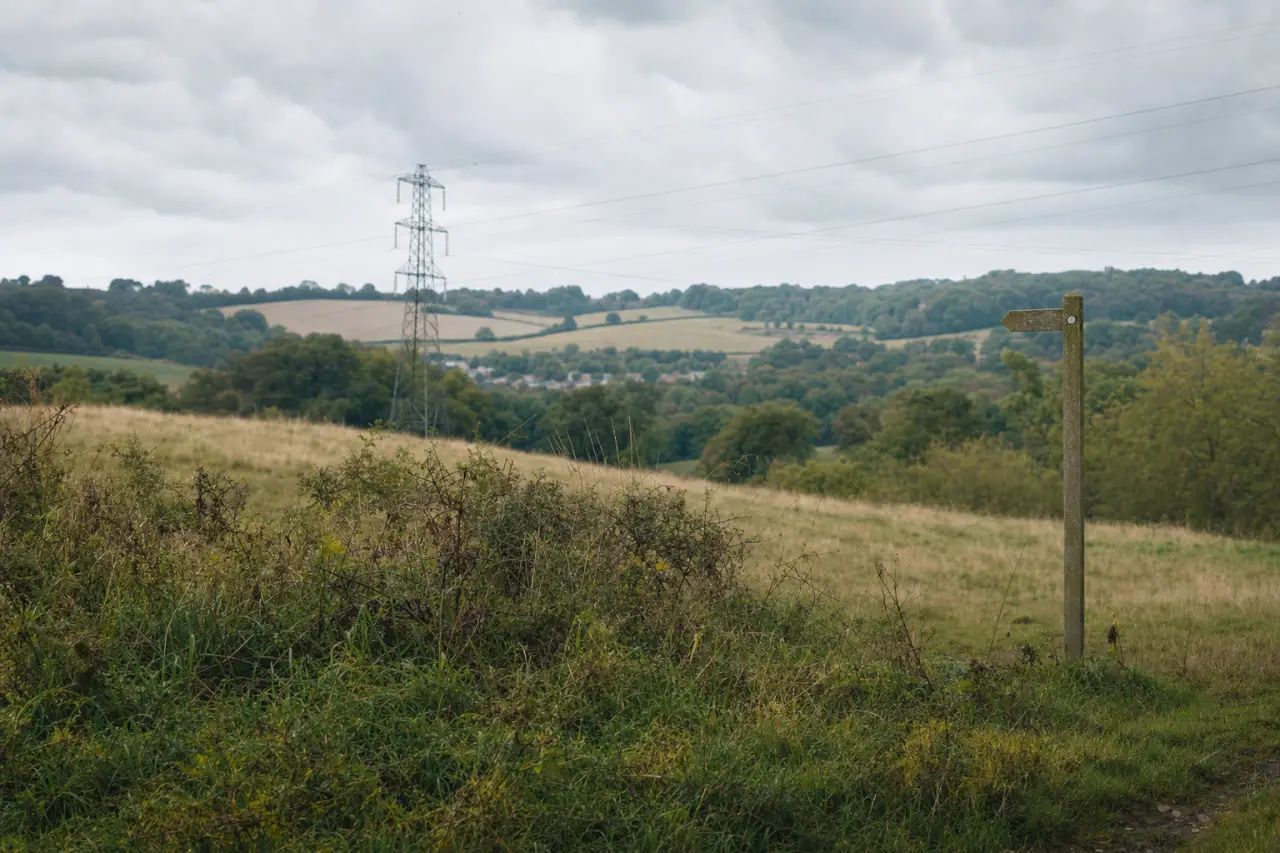
How to Check for Pylons and Power Lines on Land: Compensation, Health Risks and Property Value Impact
Electricity pylons and overhead power lines can significantly affect land value, development potential, and even your legal rights as a landowner. Whether you're considering purchasing land that already has power infrastructure or discovering existing wayleaves during due diligence, understanding the implications is crucial for making an informed decision.
In this comprehensive guide, we'll explain how to identify power lines before purchase, what compensation you're entitled to, the health and safety considerations, and how pylons affect property values across the UK in 2026.
Understanding Pylons and Power Lines on UK Land
The UK's electricity transmission network comprises approximately 22,000 pylons carrying high-voltage power lines across England, Wales, Scotland, and Northern Ireland. These structures are owned and operated by National Grid, Scottish Power Energy Networks, and Scottish and Southern Electricity Networks (SSEN).
Types of Power Lines You'll Encounter
High-voltage transmission lines (275kV to 400kV) are carried by large steel lattice pylons, typically 50 metres tall, and transmit electricity over long distances. These are the most visually prominent and valuable in terms of compensation.
Lower-voltage distribution lines (11kV to 132kV) use smaller wooden poles or steel structures and distribute power to local areas. These generally attract lower wayleave payments but still impact land use.
Underground cables are increasingly common for new installations, though retrofitting existing overhead lines underground remains expensive and rare.
How to Check for Power Lines Before Buying Land
Before committing to a land purchase, thorough due diligence is essential. Here's how to identify existing or planned power infrastructure:
Physical Site Inspection
The most obvious method is visiting the land in person. Walk the entire perimeter and interior, looking upward for overhead cables. Pylons are highly visible, but lower-voltage lines on wooden poles can be easy to miss, especially in wooded areas.
Bring binoculars to check for cables that may run along boundaries or cross corners of the property. Take photographs and note the approximate height and direction of any lines.
Title Deeds and Land Registry Documents
Request the official title register and title plan from Land Registry as part of your conveyancing process. Wayleave agreements and easements for power lines should appear as entries on the register, though older agreements may not always be formally recorded.
Look for any references to "easements," "wayleaves," or specific utility companies in the charges register. The title plan may show the approximate route of overhead lines, though this isn't always precise.
Contact the Distribution Network Operator (DNO)
Each region in the UK has a designated DNO responsible for local electricity infrastructure:
- England and Wales: National Grid, UK Power Networks, Electricity North West, Northern Powergrid, Scottish Power Energy Networks, SSE
- Scotland: Scottish Power Energy Networks (South), SSE (North)
- Northern Ireland: Northern Ireland Electricity Networks
Contact the relevant DNO with the property address or land registry title number. They can confirm whether any assets cross or are adjacent to the land and provide details of existing agreements.
Online Mapping Tools
Several free and paid services can help identify power infrastructure:
National Grid's Overhead Line Route Maps are available online and show the approximate routes of high-voltage transmission lines across England and Wales.
Ordnance Survey maps often mark major pylons and power lines, though coverage varies by scale and age of the map.
Google Earth and satellite imagery can reveal larger pylons and their shadows, though smaller distribution lines may not be visible.
Environmental Searches
A comprehensive environmental search conducted by your solicitor should identify nearby electricity infrastructure as part of standard conveyancing. However, these reports sometimes miss smaller distribution lines or focus only on major hazards.
Pylons on Land Compensation: Understanding Wayleave Payments
If electricity infrastructure crosses your land, you're legally entitled to compensation through wayleave agreements. Understanding how these work is crucial for both buyers and existing landowners.
What is a Wayleave Agreement?
A wayleave is a legal agreement between a landowner and utility company granting permission to install and maintain equipment on private land. Unlike easements (which are permanent rights attached to the land itself), wayleaves are typically annual agreements that can theoretically be terminated, though this is rarely straightforward in practice.
How Much Compensation Can You Expect?
Wayleave payments in 2026 vary significantly based on several factors:
High-voltage transmission pylons (National Grid): £500 to £15,000+ per pylon per year, depending on land use, agricultural impact, and negotiation. Prime agricultural land typically commands higher rates.
Distribution poles and lines: £50 to £500 per pole or span per year. Payments are generally lower but can accumulate if multiple structures are present.
Underground cables: £100 to £1,000 per kilometre per year, depending on depth, access requirements, and land use restrictions.
Payments are typically made annually and should increase with inflation. However, many older agreements were made at historically low rates, and landowners may not have reviewed them for decades.
Reviewing and Renegotiating Wayleave Payments
If you're purchasing land with existing wayleaves, check when the agreement was last reviewed. Many landowners don't realise they can request renegotiation, particularly if:
- Payments haven't increased in line with land values or inflation
- The land use has changed (e.g., from rough grazing to arable farming)
- Additional equipment has been installed since the original agreement
- Comparable properties are receiving higher payments
Consider engaging a specialist land agent or agricultural surveyor with experience in utility negotiations. Their fees (typically 10-20% of any payment increase) are often worthwhile for securing fair compensation.
Statutory Wayleaves vs. Voluntary Agreements
If a landowner refuses a voluntary wayleave, utility companies can apply for a statutory wayleave under the Electricity Act 1989. These provide similar rights but are imposed rather than negotiated, typically offering standard (often lower) compensation rates.
When buying land, check whether existing wayleaves are voluntary or statutory, as this affects your ability to negotiate.
Impact on Property Value and Land Prices
Electricity pylons and overhead power lines demonstrably affect land values, though the extent varies by location, land type, and development potential.
Agricultural and Amenity Land
Studies consistently show that agricultural land with overhead power lines sells for 10-20% less than comparable land without infrastructure. The impact is most significant for:
- High-grade arable land where modern machinery clearance is restricted
- Equestrian properties where horses may be disturbed by electromagnetic fields
- Smallholdings and lifestyle plots where visual amenity is important
You can get a better understanding of how these factors affect value through a professional land valuation.
Development Land
The impact is even more pronounced for land with development potential. Pylons and power lines:
- Create exclusion zones where building is prohibited (typically 3-50 metres depending on voltage)
- Reduce the developable area and complicate site layouts
- Affect the marketability of completed developments
- May trigger objections during planning permission applications
Development land affected by overhead lines may see value reductions of 20-40%, though this depends heavily on whether the lines can be diverted (at significant cost) or worked around.
Residential Property Near Pylons
Research by the Royal Institution of Chartered Surveyors (RICS) indicates that homes directly beneath or very close to pylons sell for 5-10% less than comparable properties. Homes within 100-200 metres may see smaller discounts of 2-5%.
The perceived health risks (discussed below) and visual impact drive this devaluation more than actual interference with property use.

Overhead Power Lines Health Risks: Separating Fact from Fear
Health concerns about electromagnetic fields (EMF) from power lines have been debated for decades. Understanding the current scientific consensus is important for both land buyers and residents.
What the Science Says
The UK Health Protection Agency (now part of Public Health England) has extensively studied EMF exposure. Their key findings:
- No consistent evidence links everyday exposure to power-frequency EMF with any adverse health effects in adults
- Some epidemiological studies suggest a possible association between childhood leukaemia and prolonged exposure to very high EMF levels (above 0.4 microteslas)
- The evidence is not strong enough to establish causation, and alternative explanations haven't been ruled out
- EMF levels decrease rapidly with distance from power lines
UK Government Guidelines
In 2026, UK policy continues to follow a precautionary approach recommended by the National Radiological Protection Board:
- Government opposes building new homes directly beneath high-voltage power lines
- Planning authorities should consider EMF when assessing development near major power infrastructure
- No specific "safe distances" are mandated, but typical recommendations suggest avoiding building within 50 metres of major transmission lines
Practical EMF Levels
Typical EMF exposure at various distances from a 400kV transmission line:
- Directly beneath: 1-10 microteslas
- 50 metres away: 0.2-2 microteslas
- 100 metres away: 0.1-0.5 microteslas
- Background levels: 0.01-0.2 microteslas
For context, the International Commission on Non-Ionizing Radiation Protection (ICNIRP) sets public exposure guidelines at 100 microteslas for continuous exposure, well above levels encountered near UK power lines.
Making an Informed Decision
While definitive proof of harm is lacking, the precautionary principle suggests:
- Avoid building habitable structures directly beneath high-voltage lines
- Maintain reasonable separation (50+ metres for transmission lines)
- Consider non-residential uses (storage, agriculture, parking) for land directly beneath pylons
- Prioritise building distance if purchasing land for residential development
For existing properties or agricultural land, health risks appear minimal based on current evidence, though perceived risks still affect property values.
Development Restrictions and Planning Implications
Beyond health considerations, electricity infrastructure creates concrete planning and development constraints.
Exclusion Zones and Safety Clearances
National Grid and DNOs maintain statutory clearance zones around overhead lines:
Horizontal clearances typically require 3-25 metres on either side of transmission lines, depending on voltage. No buildings or permanent structures are permitted within these zones.
Vertical clearances mandate minimum heights for any structure passing beneath lines—typically 5-7 metres for transmission lines.
These restrictions can severely limit development layouts, potentially making small plots completely unbuildable.
Planning Permission Considerations
Local planning authorities must consult National Grid and DNOs when considering applications near electricity infrastructure. Common issues include:
- Objections to residential development within close proximity to lines
- Requirements for EMF assessments and mitigation measures
- Restrictions on building heights and crane operations during construction
- Conditions requiring future access for maintenance
Understanding these constraints before purchasing land is crucial. Our complete guide to buying land covers essential due diligence steps.
Diverting or Undergrounding Lines
In exceptional cases, particularly for major development sites, it may be possible to request line diversion or undergrounding. However:
- Costs typically range from £1-5 million per kilometre for undergrounding
- The developer or landowner usually bears the full cost
- Diversions require statutory approval and extensive consultation
- Timescales typically extend 2-5 years from application to completion
These options are only viable for large-scale developments where the increased land value justifies the enormous expense.
Buying Land with Power Lines: Key Considerations
If you're considering purchasing land affected by electricity infrastructure, ask yourself:
Financial Viability
- Does the reduced purchase price adequately compensate for the devaluation?
- Are existing wayleave payments fair and regularly reviewed?
- Could future development plans be constrained?
- What are the long-term implications for resale value?
Intended Use
- Will power lines affect your planned use (agriculture, equestrian, development)?
- Are there alternative areas of the land unaffected by infrastructure?
- Could restrictions be mitigated through creative site planning?
Legal Protection
- Are all agreements properly documented in the title deeds?
- Do you understand your rights regarding maintenance access?
- Have you obtained professional legal and surveying advice?
- Can existing agreements be renegotiated or terminated?
Regional Variations Across the UK
Electricity infrastructure affects land differently depending on location:
England: The densest pylon network exists in the Midlands and North, where industrial demand is highest. Southern counties have extensive distribution networks serving residential areas.
Scotland: Large-scale transmission infrastructure connects remote renewable generation (wind farms, hydro) to population centres. Highland estates often have extensive overhead lines crossing marginal land.
Wales: Mountainous terrain means power lines often cross agricultural land in valleys, significantly affecting farm operations and valuations.
Northern Ireland: A smaller, more localised network, though planned interconnector projects may affect land in border areas.
Regional land values and agricultural practices influence both the impact and compensation levels. Check our locations guide for area-specific insights.
What Happens If You Already Own Affected Land?
Existing landowners discovering unclaimed wayleave payments or outdated agreements should:
- Identify all infrastructure on your land through physical inspection and DNO contact
- Request copies of existing agreements from the utility company and your solicitor
- Compare payments with current market rates using an agricultural surveyor or land agent
- Initiate renegotiation formally in writing, providing evidence of undervaluation
- Consider specialist advice if payments are significantly below market rates
Many landowners unknowingly forfeit thousands of pounds annually through outdated agreements that were never reviewed after initial signing decades ago.
The Future of Electricity Infrastructure and Land
The UK's transition to renewable energy and net-zero targets will significantly affect power infrastructure by 2026 and beyond:
New transmission capacity: Substantial new pylons and lines are planned to connect offshore wind farms and nuclear facilities to the grid, particularly in coastal areas of England and Scotland.
Undergrounding initiatives: While wholesale replacement is unlikely due to cost, new developments in sensitive areas increasingly favour underground cables.
Smart grid technology: May reduce the need for some new transmission capacity, though overall expansion remains necessary.
Compensation frameworks: Pressure from landowner groups may lead to standardised, more generous wayleave payment structures.
Prospective land buyers should consider both existing infrastructure and planned developments when assessing long-term value and use potential.
Conclusion: Making an Informed Decision
Electricity pylons and power lines are a significant consideration when buying land, affecting everything from property values to development potential, health perceptions, and annual income through wayleaves.
Successful land purchases involving power infrastructure require:
- Thorough due diligence using physical inspections, title searches, and DNO consultation
- Realistic financial assessment of devaluation versus reduced purchase price
- Clear understanding of compensation rights and fair payment levels
- Consideration of health evidence and planning restrictions
- Professional advice from solicitors, surveyors, and land agents with utility experience
While power lines undoubtedly complicate land ownership, they don't necessarily make land a poor investment. Many buyers successfully negotiate reduced purchase prices that more than compensate for the inconvenience, particularly for agricultural or non-residential uses where impact is minimal.
The key is entering negotiations fully informed about rights, risks, and realistic value adjustments for the UK market in 2026.
Get Expert Valuation for Land with Power Lines
Considering purchasing land affected by electricity infrastructure? Our professional valuation service accounts for all factors including existing wayleaves, development restrictions, and market conditions. Get your free land valuation today to understand the true value and potential of your prospective purchase.
For more guidance on navigating complex land purchases, explore our comprehensive resources on planning permission and the complete buying process.
Get a Free Land Valuation
Use our calculator to get an instant estimate of land value in your area.
Free Valuation